Importing the Toyota Aristo (JZS147) to the USA: 2026 Costs
The four-door that introduced the twin-turbo 2JZ-GTE nearly two years before the Supra, and the version Japan kept for itself.

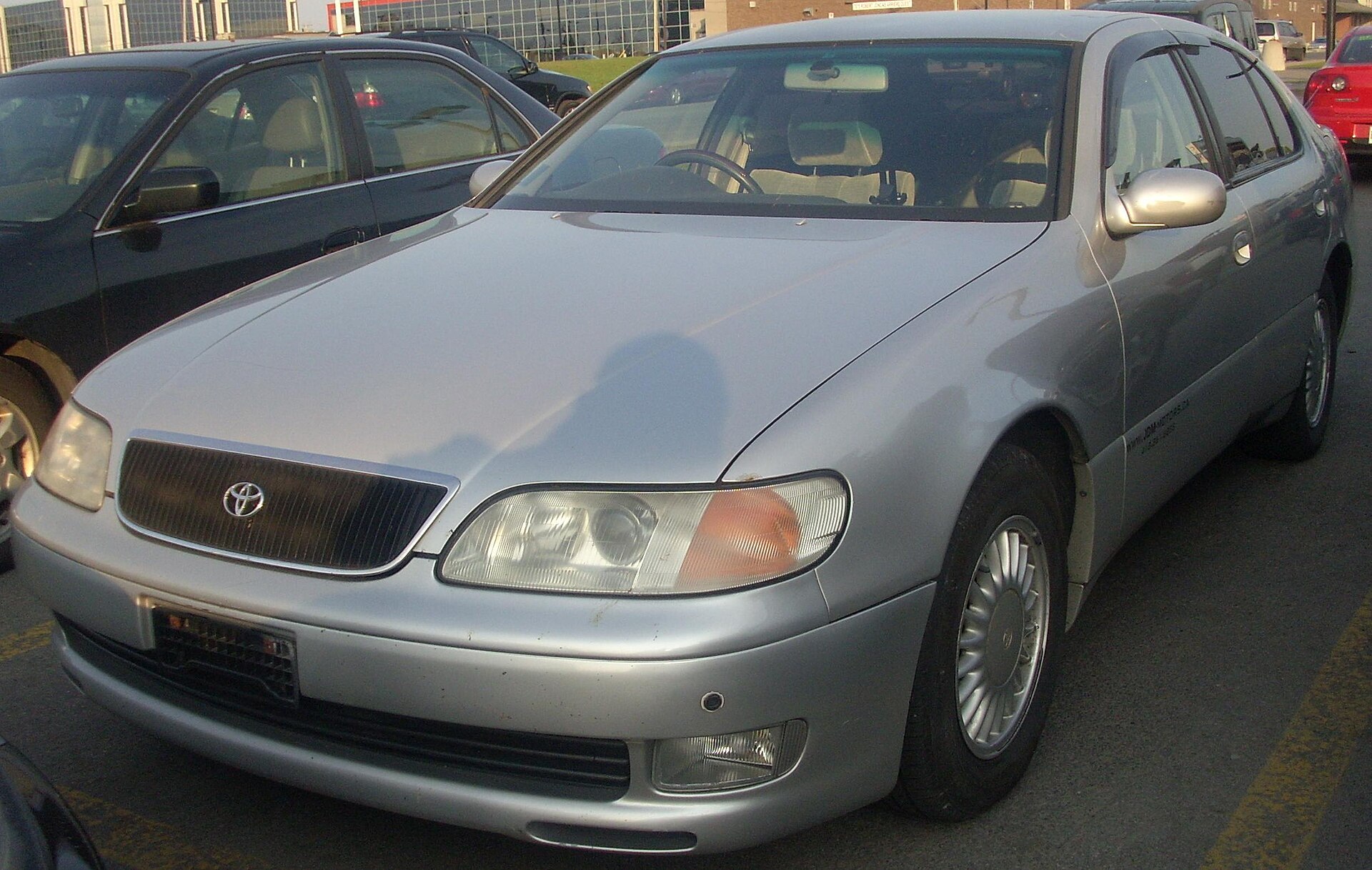
The JZS147 3.0V holds a distinction most enthusiasts skip past: it carried Toyota's twin-turbo 2JZ-GTE from October 1991, roughly eighteen months before the A80 Supra inherited the same engine. Buy a clean Aristo and you own the car that launched the legend, not the one that borrowed it.
Americans got this chassis as the first Lexus GS300, but only with the naturally aspirated 2JZ-GE. The 280-PS sequential-turbo Aristo never left Japan, which is precisely why one now rides a container across the Pacific to a US driveway.
Launched in 1991 with Italdesign lines and flagship ambitions, the first-generation Aristo was Toyota's answer to the German sports sedan. The 3.0V mattered because it debuted the 2JZ-GTE, an iron-block inline-six with sequential twin turbos rated at a deliberately conservative 280 PS. That engine, later immortalized by the A80 Supra, is famous for swallowing boost with the block intact. A luxury four-door hiding the same architecture is the Aristo's enduring appeal.
Values have climbed as the survivor pool thins, largely because so many 3.0Vs were stripped as engine donors. That makes an unmolested, standard car the one to chase, and the one that commands a premium. Verify it is genuinely a 3.0V and not the naturally aspirated 3.0Q, since both share the JZS147 code. Scrutinize the auction sheet for rust, check the timing-belt history on this interference engine, and treat a tired four-speed automatic as a real line item.
Most cars are bought through a Japanese auction agent, deregistered, and shipped by RoRo or container to a West Coast port, after which you clear customs and register at home. The paperwork is routine when the export certificate, its translation, and the kilometer odometer all line up. The classic trap is originality: donor-car candidates, swapped engines, and optimistic mileage are common, so a pre-purchase inspection and a legible auction sheet are worth far more than a low headline price.
The full cost breakdown
Every line below is a researched 2026 estimate in USD. We start from the $20,000 purchase price, add marine insurance at about 1.5% and ocean freight, then 2.5% US duty on the declared value, and the broker, compliance and registration fees. Change the purchase price and everything else scales only modestly.
| Vehicle (purchase price) | $20,000 |
| Export agent & auction fees | $1,200 |
| Ocean freight | $2,800 |
| Marine insurance (~1.5%) | $300 |
| The standard US passenger-car import duty is 2.5% of declared value | $500 |
| Customs broker & port handling | $830 |
| EPA / DOT entry & compliance paperwork | $300 |
| Inland transport & registration | $1,500 |
| Estimated all-in landed cost | $27,430 |
Into USA the duty is light, just $500, so tax is the small part of the bill. It is shipping (about $2,800), compliance and registration that make up most of the roughly $7,430 you add on top of the $20,000 purchase price — around 37% before you turn a wheel.
Step by step: how importing this car works
- Agree the purchase and secure the title/export paperwork in Japan (an export agent or auction house usually handles de-registration).
- Book ocean freight — roll-on/roll-off (RoRo) is cheapest, a sole-use container is safest for a high-value car.
- Confirm eligibility from the build month — the US 25-year DOT exemption is calculated month by month, not by model year.
- Clear US customs and pay the 2.5% duty, then file EPA Form 3520-1 and DOT Form HS-7 at entry.
- Arrange inland transport, then title and register in your state — a few states add emissions or kei-vehicle checks.
Compliance & the fine print
Every JZS147 left the line between 1991 and 1997, so in 2026 the entire run clears the NHTSA 25-year rule and enters without meeting FMVSS crash or lighting standards; you claim the exemption on the HS-7 form. On the emissions side, a vehicle at least 21 model years old in original, unmodified configuration is exempt from EPA requirements, filed on form 3520-1. Passenger cars carry a 2.5 percent federal import duty, and right-hand drive is legal for federal registration and in nearly every state.
Frequently asked questions
How do I know it's the twin-turbo and not the naturally aspirated version?+
Both the NA 3.0Q and the twin-turbo 3.0V wear the JZS147 chassis code, so the badge alone won't settle it. Confirm the engine itself, count the two sequential turbochargers, and cross-check the auction sheet and grade against the model designation before you bid.
Did the Aristo ever come with a manual gearbox?+
No. Toyota only offered the JZS147 with a four-speed automatic; the factory manual 2JZ-GTE lives in the Supra. Any Aristo advertised with three pedals has been converted, which changes its value and undercuts any originality claim on your import paperwork.
What is the total estimated cost to import a Toyota Aristo (JZS147)?+
About $27,430 all-in for a $20,000 example — the purchase price plus roughly $7,430 in freight, insurance, duty, compliance and registration. Your figure shifts with the exact price, route and exchange rate.
Read next
Importing a Nissan Skyline R34 to the USA: the true 2026 cost
Importing a Toyota Supra MK4 (A80) to the USA in 2026